The Filth and the Fury
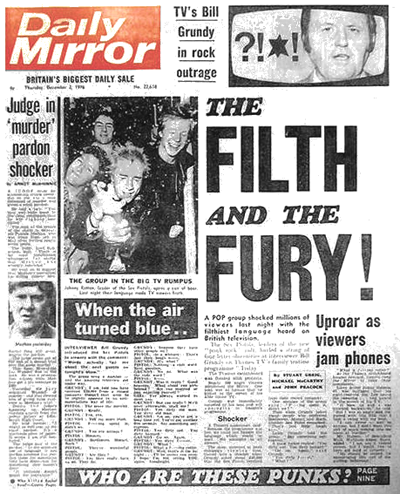
December 1st 1976, the Sex Pistols appear on The Today Show as replacement for Queen. That moment informed the mainstream about punk and the moment the media turned against it. From then, the movement was slandered, disregarded and outcast; punk was the black sheep of the arts world. The next day, arguably one of the most notorious headlines to ever occupy the front page, was printed across millions of copies of the Daily Mirror.
“You dirty fucker, what a fucking rotter” is not what primetime viewers expected to be broadcast, especially when Britain seemed stuck in a backwards rut, the fashion was brown, the morals conservative and a generation of teenagers were yet to find their voice. That was the beginning of a liberation, one however that wasn’t going to be understood. By 1977 venues wouldn’t book punk bands. Even the popular clubs from the year before began to disassociate themselves from the raucous that typically came with a gig. Punk was becoming as illicit as the drugs Ian Curtis was ingesting. The height of the controversy came with the charting, or lack of in this case, of “God Save the Queen”, one of the Pistol’s most recognizable tracks. Coinciding with the Silver Jubilee, the song quickly began to rack up sales, it was destined for the top of the chart. However, the top slot was left blank. The #1 that was never #1. You can’t get more punk rock than that!
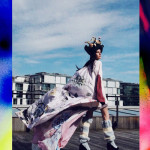
Music and fashion go hand in hand, and the role Vivienne Westwood played is one of the greatest success stories of the British fashion industry. In her own words “Malcolm McLaren and I invented punk”. During the hedonism of the late 70s, apparel was used as a political statement, rearing its head against the governmental system. Much like in the music scene, Westwood faced prejudice from more traditional ready-to-wear designers. Her collections continued to be misunderstood, with quirky themes like Nostalgia of Mud, Witches, and Hypnos, with inspiration drawn from historic silhouettes such as the corset. Westwood fought against the criticism, continuing to design and utilizing British fabrications. In 1990, ten years after punk faded, Westwood was awarded Womenswear Designer of the Year at the British Fashion Awards. “The Designer of the Year is, oh dear, Vivienne Westwood” announced the presenter, proving that even 15 years into her career, she was still seen as somewhat radical.
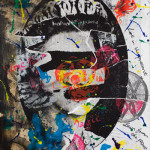
Today punk is still present, it is just more subliminal than in the 1970s, the legacy is there we just see it without realising. The creative industry incorporates many of the original themes, modern art is reminiscent of the moment with bold, fearless colours splashed in organised chaos across a page. Westwood continues to strive and the ideologies of punk are inspiring new designers. It’s apparent that punk was never appreciated, but the freedom it gave artists and expressionists should never be forgotten. Without punk, the liberal arts we experience maybe very different. Without punk, On/Off may not even exist.
by James Underdown